Harrison County Dog Registration Information
Service Dogs and Emotional Support Animals in Harrison, Kentucky
Registering a Service Dog or Emotional Support Dog in Harrison County, Kentucky
If you’re searching where do I register my dog in Harrison County, Kentucky for my service dog or emotional support dog, the most important thing to know is this: dog registration (licensing) and service/ESA status are different processes. In most Kentucky communities, a dog license in Harrison County, Kentucky (when required) is handled locally—through a city office, county office, or the local health/animal control system—while service dog status is based on training and federal law rather than a county-issued “service dog registration.”
This page explains where to register a dog in Harrison County, Kentucky, what agencies typically handle rabies compliance and animal control, and how to avoid confusion between a standard dog license, a service dog, and an emotional support animal (ESA).
Where to Register or License Your Dog in Harrison County, Kentucky
Licensing is often handled at the county or city level. The offices below are common starting points for animal control dog license Harrison County, Kentucky questions, rabies tag records, bite reporting, and local ordinances. If one office does not issue licenses directly, they can usually tell you the correct local contact for your address (city limits vs. county).
Example Official Offices (Harrison County, KY)
| Office | Address | Phone | Hours | |
|---|---|---|---|---|
|
City of Cynthiana (City Hall)
City office (useful if you live within Cynthiana city limits)
|
141 E Pike Street, Suite 1 Cynthiana, KY 41031 |
(859) 234-7150 | Not listed for general licensing on the city “Find Us” section | Not listed on the “Find Us” section |
|
City of Cynthiana (City Clerk contact listed by KY DLG)
City clerk contact (helpful for local ordinances and city process)
|
141 East Pike Street, Suite 1 (PO Box 67) Cynthiana, KY 41031 |
(859) 234-7150 | elizabeth.kitchen@cynthianaky.com | Not listed on KY DLG directory entry |
|
WEDCO District Health Department (Harrison County Health Center & Administrative Office)
Rabies program support, environmental health, bite reporting coordination
|
364 Oddville Avenue Cynthiana, KY 41031 |
866-759-3326 | Not listed on this contact page for the Harrison County location |
Mon–Fri 8:00 a.m.–4:30 p.m. Closed 12:00 p.m.–1:00 p.m. |
|
WEDCO District Health Department (Harrison County listing in KY Local Health Department directory)
Alternate listing for the same local health center
|
364 Oddville Avenue Cynthiana, KY 41031 |
859-234-2842 | Not listed for this specific local center in the directory table | Not listed in the directory table for this location |
Addresses and contact details shown above come from official or government-adjacent sources (City of Cynthiana site, KY DLG directory, and WEDCO contact information). (cynthianaky.com)
Overview of Dog Licensing in Harrison County, Kentucky
What “dog registration” usually means
In most places, “registering your dog” refers to a local dog license—a record that connects a dog and owner, often tied to rabies vaccination and identification tags. People often search where to register a dog in Harrison County, Kentucky when they:
- moved to Harrison County and want to follow local rules
- need proof of compliance for housing, a landlord, or a city requirement
- are trying to make sure their dog is properly tagged after a rabies vaccine
- have questions about animal control enforcement or a dog-at-large complaint
Who enforces rabies rules in Kentucky
Rabies control in Kentucky is governed by state law (KRS Chapter 258) and supported by public health guidance. The state’s rabies program information points residents to work with local health departments and animal control when bites or exposures occur. (chfs.ky.gov)
How Dog Licensing Works Locally in Harrison County, Kentucky
Local handling: city vs. county
The practical answer to “where do I register my dog in Harrison County, Kentucky” depends on where you live:
- If you live inside a city’s limits (like Cynthiana): licensing or dog-related ordinances may be administered by city offices (often the clerk/treasurer, city hall, or a designated department). The City of Cynthiana provides its city hall address and main phone number, and the KY DLG directory also lists a city clerk contact email. (cynthianaky.com)
- If you live outside city limits in unincorporated Harrison County: animal issues may route through county-level animal control, the sheriff/dispatch for certain complaints, and the local health department for rabies-related matters (vaccination clinics, exposure guidance, bite reporting coordination, and quarantine direction when applicable).
Rabies vaccination requirements (Kentucky)
Kentucky law requires rabies vaccination for dogs (and also cats and ferrets) over a specified age, and local public health agencies commonly coordinate rabies clinics and maintain related documentation systems. Kentucky Administrative Regulations also address mass rabies immunization clinics sponsored by local health departments (with authority tied to KRS 258.043). (apps.legislature.ky.gov)
For residents, this usually means you should keep proof of current rabies vaccination readily available. It’s one of the most common documents requested for local licensing and can become important if there is a bite incident or an animal control investigation.
A practical “do this first” checklist
- Confirm your address type: Cynthiana city limits vs. Harrison County (outside city limits).
- Make sure rabies vaccination is current and keep a copy of the vaccination record/receipt.
- Call the appropriate local office (City Hall/City Clerk for city addresses; WEDCO for rabies/public health direction) to ask:
- Whether a local dog license is required for your address
- Where to obtain it and what proof is needed
- Whether there are renewal deadlines or annual fees
- Ask what tag(s) should be on the collar (rabies tag, license tag, or both).
Service Dog Laws in Harrison County, Kentucky
Service dogs are defined by training and tasks (not by registration)
A service dog is a dog that is individually trained to do work or perform tasks for a person with a disability. If the dog is trained to perform a task related to a person’s disability, it qualifies as a service animal under the ADA.
What businesses can ask (and what they can’t)
Under ADA guidance, businesses and other covered entities generally cannot require documentation or proof that the dog has been certified, trained, or licensed as a service animal. When the need for the service dog isn’t obvious, they can generally ask only:
- whether the dog is required because of a disability, and
- what work or task the dog has been trained to perform.
How this relates to a dog license in Harrison County, Kentucky
Even if your dog is a service dog, local rules can still require rabies vaccination and may still require a dog license in Harrison County, Kentucky if your local jurisdiction issues licenses. In other words, service dog status impacts public access rights under disability law, but it does not automatically replace local public health requirements like rabies vaccination.
Emotional Support Animal Rules in Harrison County, Kentucky
ESAs are not service animals under the ADA
An emotional support animal (ESA) provides comfort or emotional support, but ESAs are not treated as “service animals” for public-access purposes under the ADA. That means an ESA generally does not have the same access rights to restaurants, stores, or other public places that a trained service dog has.
Where ESAs matter most: housing (reasonable accommodation)
ESAs are most commonly addressed through housing rules (not public access). HUD’s guidance discusses “assistance animals” in housing and explains the reasonable accommodation framework for people with disabilities who need an assistance animal, including animals that provide therapeutic emotional support. (hud.gov)
How ESA rules relate to local dog registration
Even if your dog is an ESA, you should still treat local registration and rabies compliance as separate requirements. If a landlord requests paperwork for an ESA accommodation, that is different from asking for a county-issued “ESA license.” For local government purposes, you are typically working with the same local requirements that apply to any dog owner: licensing (if applicable in your area) and rabies vaccination compliance.
Frequently Asked Questions
You generally do not need a special government registration to make your dog a service dog. Under ADA guidance, a service animal is defined by being a dog individually trained to perform tasks related to a person’s disability, and covered entities generally cannot require proof of certification or licensing as a condition of entry.
However, local public health and animal control rules (such as rabies vaccination requirements and any local dog licensing rules) may still apply.
- City address (Cynthiana): Start with the City of Cynthiana (City Hall) and ask whether your address is subject to city dog licensing requirements and where the license is issued. (cynthianaky.com)
- Rabies questions, clinics, bite reporting: Start with WEDCO District Health Department (Harrison County office in Cynthiana). (wedcohealth.org)
Requirements vary locally, but the most common starting point is proof of current rabies vaccination (and often ID and proof of residency). Kentucky public health materials and local health department processes emphasize rabies compliance under Kentucky law and related regulations. (chfs.ky.gov)
For the exact local list and fee schedule, call the appropriate local office listed above and ask what applies to your address.
No. A service dog is trained to perform tasks related to a disability and is addressed under ADA service animal rules. ESAs are generally handled through housing-related reasonable accommodation frameworks (HUD guidance) rather than public-access rights.
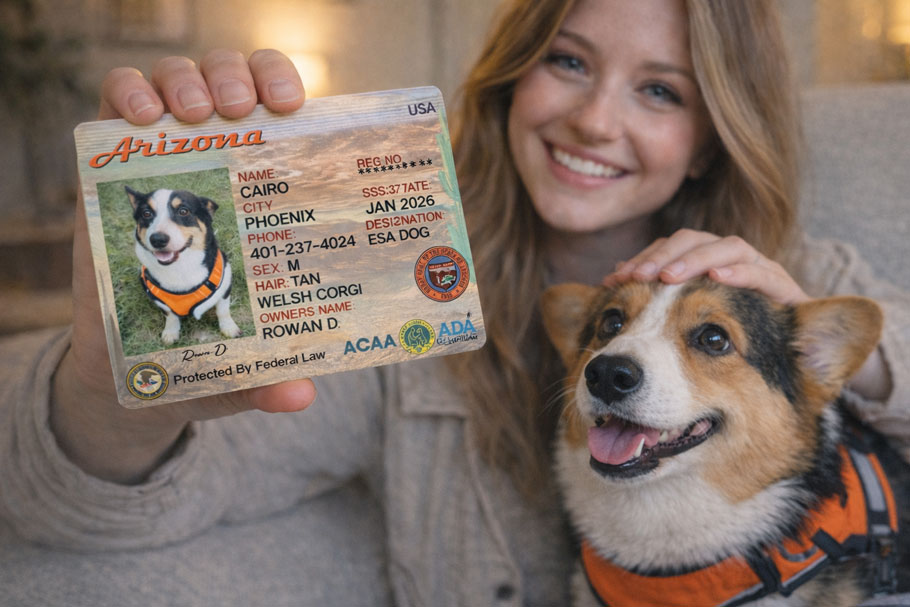
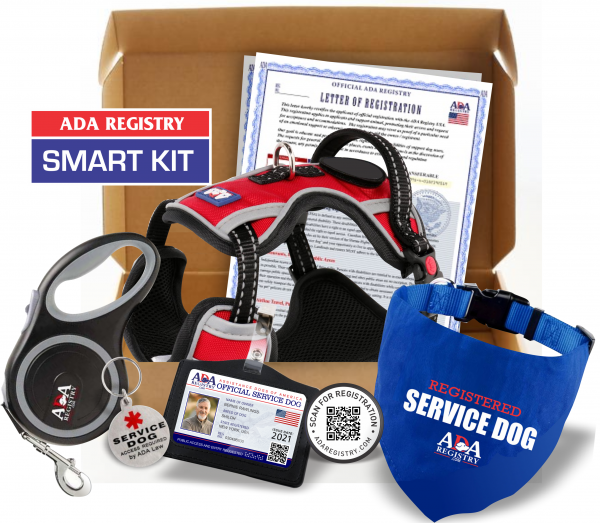
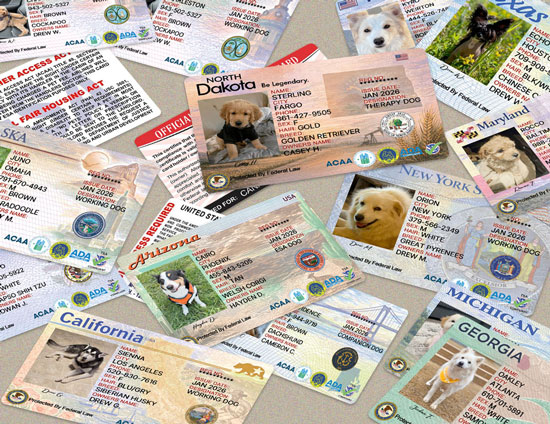
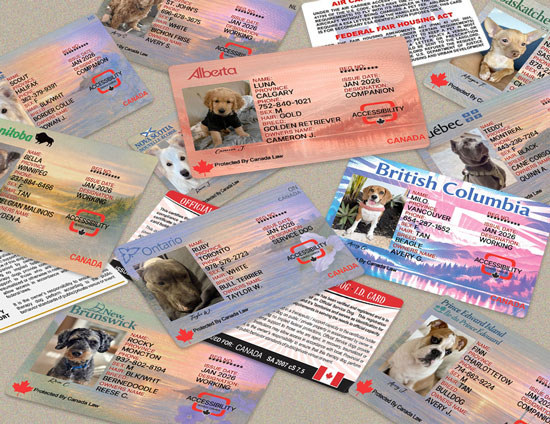
Buying an online certificate is not the same as local dog licensing and does not create ADA service-dog status. ADA guidance states covered entities may not require documentation as proof that a dog is a service animal, and such documents do not convey ADA rights. (ada.gov)
Register A Dog In Other Kentucky Counties
Select your county below to get started with your dog’s ID card. Requirements and license designs may vary by county, so choose your location to see the correct options and complete your pup’s registration.
- Adair County Dog Registration
- Allen County Dog Registration
- Anderson County Dog Registration
- Ballard County Dog Registration
- Barren County Dog Registration
- Bath County Dog Registration
- Bell County Dog Registration
- Boone County Dog Registration
- Bourbon County Dog Registration
- Boyd County Dog Registration
- Boyle County Dog Registration
- Bracken County Dog Registration
- Breathitt County Dog Registration
- Breckinridge County Dog Registration
- Bullitt County Dog Registration
- Butler County Dog Registration
- Caldwell County Dog Registration
- Calloway County Dog Registration
- Campbell County Dog Registration
- Carlisle County Dog Registration
- Carroll County Dog Registration
- Carter County Dog Registration
- Casey County Dog Registration
- Christian County Dog Registration
- City of Lexington County Dog Registration
- City of Louisville County Dog Registration
- Clark County Dog Registration
- Clay County Dog Registration
- Clinton County Dog Registration
- Commonwealth of Kentucky County Dog Registration
- Crittenden County Dog Registration
- Cumberland County Dog Registration
- Daviess County Dog Registration
- Edmonson County Dog Registration
- Elliott County Dog Registration
- Estill County Dog Registration
- Fayette County Dog Registration
- Fleming County Dog Registration
- Floyd County Dog Registration
- Franklin County Dog Registration
- Fulton County Dog Registration
- Gallatin County Dog Registration
- Garrard County Dog Registration
- Grant County Dog Registration
- Graves County Dog Registration
- Grayson County Dog Registration
- Green County Dog Registration
- Greenup County Dog Registration
- Hancock County Dog Registration
- Hardin County Dog Registration
- Harlan County Dog Registration
- Hart County Dog Registration
- Henderson County Dog Registration
- Henry County Dog Registration
- Hickman County Dog Registration
- Hopkins County Dog Registration
- Jackson County Dog Registration
- Jefferson County Dog Registration
- Jessamine County Dog Registration
- Johnson County Dog Registration
- Kenton County Dog Registration
- Knott County Dog Registration
- Knox County Dog Registration
- LaRue County Dog Registration
- Laurel County Dog Registration
- Lawrence County Dog Registration
- Lee County Dog Registration
- Leslie County Dog Registration
- Letcher County Dog Registration
- Lewis County Dog Registration
- Lincoln County Dog Registration
- Livingston County Dog Registration
- Logan County Dog Registration
- Lyon County Dog Registration
- Madison County Dog Registration
- Magoffin County Dog Registration
- Marion County Dog Registration
- Marshall County Dog Registration
- Martin County Dog Registration
- Mason County Dog Registration
- McCracken County Dog Registration
- McCreary County Dog Registration
- McLean County Dog Registration
- Meade County Dog Registration
- Menifee County Dog Registration
- Mercer County Dog Registration
- Metcalfe County Dog Registration
- Monroe County Dog Registration
- Montgomery County Dog Registration
- Morgan County Dog Registration
- Muhlenburg County Dog Registration
- Nelson County Dog Registration
- Nicholas County Dog Registration
- Ohio County Dog Registration
- Oldham County Dog Registration
- Owen County Dog Registration
- Owsley County Dog Registration
- Pendleton County Dog Registration
- Perry County Dog Registration
- Pike County Dog Registration
- Powell County Dog Registration
- Pulaski County Dog Registration
- Robertson County Dog Registration
- Rockcastle County Dog Registration
- Rowan County Dog Registration
- Russell County Dog Registration
- Scott County Dog Registration
- Shelby County Dog Registration
- Simpson County Dog Registration
- Spencer County Dog Registration
- Taylor County Dog Registration
- Todd County Dog Registration
- Trigg County Dog Registration
- Trimble County Dog Registration
- Union County Dog Registration
- Warren County Dog Registration
- Washington County Dog Registration
- Wayne County Dog Registration
- Webster County Dog Registration
- Whitley County Dog Registration
- Wolfe County Dog Registration
- Woodford County Dog Registration